
Private AI: Self-Hosted LLMs in Your Own Cloud
We design and deploy open-weight language models inside your private cloud tenant, so sensitive data stays within your network and under your governance.
Last updated: 2026-10-07
 Azure
 Google Cloud
 Hugging Face
 Kubernetes
 Docker
 Llama
 Mistral
 vLLM
Product names and logos are trademarks of their respective owners. Their use here does not imply endorsement.
For organizations in regulated sectors such as finance, healthcare and pharma, sending proprietary code, financial records or patient data to an external LLM API raises real compliance questions under the Swiss FADP and EU GDPR: lawful basis, processor agreements, cross-border transfers and auditability. Enterprise API offerings can answer some of these. For the most sensitive workloads, or where regulators or internal policy require it, running the model inside your own cloud tenant is often the cleaner answer.
Open-weight models such as Qwen and Mistral now come close to proprietary frontier models on many enterprise tasks, such as extraction, summarization and retrieval over internal documents. Performance depends on the task, so we benchmark candidate models on your own data before recommending one.
At a glance
- What:
- Self-hosted open-weight LLMs deployed in your own Azure or GCP tenant
- For:
- Regulated organizations with sensitive data
- Includes:
- Architecture design, secure deployment, enterprise integration, ongoing support
- How it starts:
- A free 30-min architecture call
The Case for Open-Weight Models
Open-weight models provide a practical path for enterprises that need performance, control and deployment flexibility without depending on a single external API vendor. Licenses vary by model, so we review them against your use case.
The open-weight AI ecosystem has progressed rapidly. Models such as Llama and Mistral now come close to proprietary frontier models on many enterprise tasks while giving organizations more control over data handling, model updates and infrastructure boundaries.
- Complex reasoning & extraction: Handling structured extraction, semantic parsing and multi-step agentic workflows across enterprise data.
- Domain specialization: Allowing retrieval, fine-tuning and orchestration on proprietary corpora without exposing the raw data to an external provider.
- Cost predictability: Replacing difficult-to-estimate per-token API spend with transparent cloud compute costs and infrastructure planning.
When self-hosting makes sense, and when it doesn’t
Makes sense when:
- Your data is highly sensitive or regulated
- A regulator or internal policy requires data to stay in your tenant
- You have sustained, high-volume workloads
- You want to fine-tune on proprietary data
- You want to avoid vendor lock-in
Probably doesn't when:
- Your volume is low or sporadic (APIs are usually cheaper)
- You need the very top frontier capability for hard reasoning tasks
- The data is not sensitive
- You have no capacity to operate the infrastructure and don't want a support arrangement
Sometimes an enterprise API with a data processing agreement and regional hosting is the right answer. We will tell you if that is the case.
Private Architecture and Network Isolation
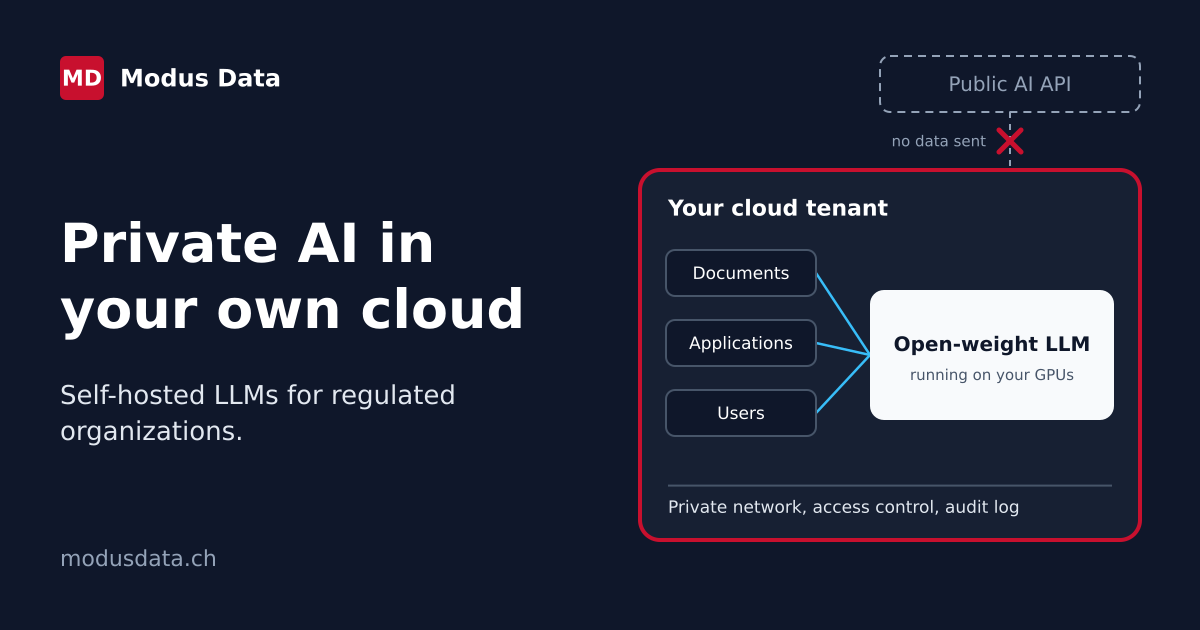
At Modus Data, we design private AI environments from the ground up so that inference traffic stays on private networks inside your tenant, with no public ingress or egress paths for data payloads.
Secure Network Boundaries & Traffic Flow
By deploying model weights directly into your private cloud tenant, inference traffic remains isolated from the public internet:
- VPC / VNet peering & private endpoints: Client applications, orchestrators, vector databases and the inference runtime communicate over private IP space inside your network boundary.
- Enterprise authentication & IAM integration: Access is authenticated, and requests are logged for audit according to your retention policy. Identity providers such as Microsoft Entra ID and Okta can enforce role-based access control and scoped tokens.
Leveraging Enterprise Cloud Infrastructure: Azure and GCP Ecosystems
Building a private AI stack requires robust, enterprise-proven cloud tooling. We leverage native services across major cloud platforms to deploy, scale and monitor private LLMs securely:
Microsoft Azure Ecosystem
- Azure Container Apps (ACA) / Azure Kubernetes Service (AKS): Hosting containerized inference runtimes such as vLLM with dedicated GPU node pools for high-throughput generation.
- Azure Virtual Networks & Private Link: Keeping inference services and vector stores behind private endpoints, so data stays within your tenant boundary.
- Microsoft Entra ID: Enforcing zero-trust access controls across APIs, services and internal tooling.
Google Cloud Platform (GCP) Ecosystem
- Google Kubernetes Engine (GKE) & Vertex AI Model Garden: Deploying open-weight models on managed GPU clusters with custom serving runtimes.
- VPC Service Controls: Establishing security perimeters around your Google Cloud projects and restricting access to authorized internal networks only.
- Cloud Armor & IAM: Providing layered defense, fine-grained access control and audit logging for all data pipelines.
Managed services such as Vertex AI Model Garden or Azure AI Search can be part of the design where your policies allow; fully self-managed alternatives are available.
Data residency and sovereignty
We deploy into your Azure or GCP tenant, in the region you choose, including Swiss regions where the required GPU capacity is available (GPU availability varies by region and is verified during scoping). Hyperscaler infrastructure remains subject to the provider’s legal jurisdiction. Where this matters for your risk assessment, we discuss mitigations such as customer-managed encryption keys, region restrictions enforced by policy, and Swiss/EU provider options, if offered.
Cost: what to expect
Self-hosting swaps per-token API fees for fixed GPU infrastructure costs. That is predictable, and it typically pays off at sustained high volume; at low volume, APIs are usually cheaper. We model both scenarios for your expected usage before you commit. See our packages for engagement pricing.
What we deliver
- Architecture Design: Customized blueprints for self-hosted LLM stacks
- Secure Cloud Deployment: Production installation on Azure or GCP
- Enterprise Integration: Workflows, governance controls and MLOps telemetry
- Expert Support: Hands-on guidance from initial strategy through rollout and optimization
FAQ
Is self-hosting legally required?
No. Using external APIs is not prohibited by the FADP or GDPR, but it requires a lawful basis, appropriate agreements and a transfer assessment. Whether self-hosting is the right choice depends on your data, sector and risk assessment. We are not a law firm, so involve your legal and data protection teams.
How do open-weight models compare with proprietary ones?
It depends on the task. We benchmark on your data and recommend a model based on results, not reputation.
Which clouds do you support?
Azure and GCP.
Who operates the system after go-live?
Depending on client needs, fractional retainer packages can be arranged or a handover to corporate internal personnel.
What does it cost?
Infrastructure costs plus a project fee. See our packages, or book a call for an estimate.
Build Private AI with Modus Data
Secure cloud architecture and clear governance help you unlock the value of private AI without turning your enterprise into a public API dependency. Whether you are automating clinical document review, building internal enterprise assistants, or deploying multi-agent workflows, Modus Data helps you move from strategy to production with the controls your environment requires.
Need a tailored architecture review for your own tenant? Book a free 30-minute call.