
A hybrid BTP/Azure architecture for agentic AI integration into SAP
Enterprise support teams often have to route thousands of complex SAP requests across dozens of technical categories. Manual triage slows resolution, while sending every ticket directly to a large language model introduces avoidable latency, cost, and governance risk.
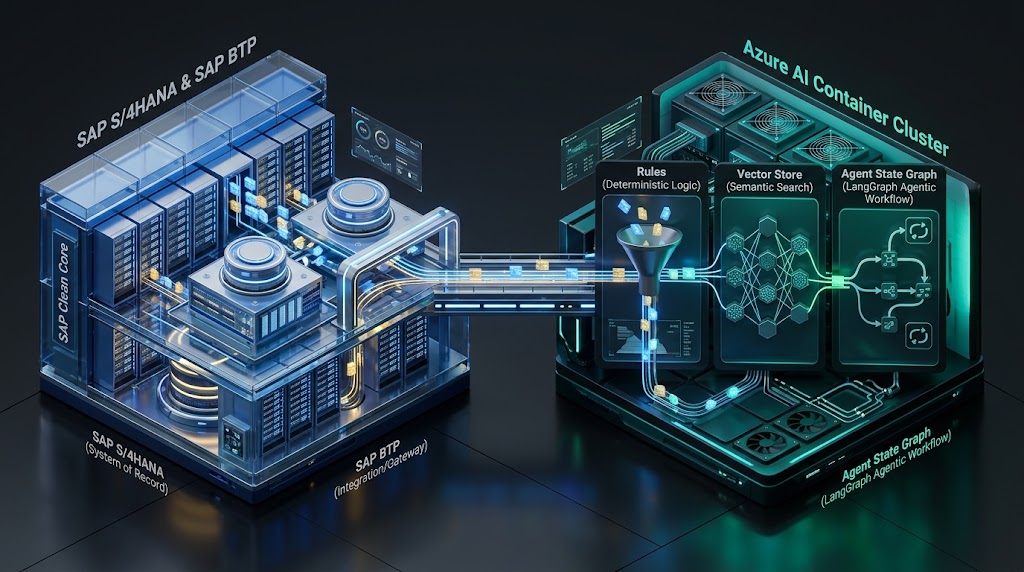
At Modus Data, we designed a production-grade classification funnel that keeps SAP S/4HANA clean, separates enterprise integration from AI compute, and runs all three classification stages inside one LangGraph orchestration service hosted on Azure Container Apps.
The architectural challenge
The solution had to satisfy three constraints at the same time:
- ERP integrity: Custom logic inside SAP S/4HANA would increase upgrade risk and work against SAP’s Clean Core strategy.
- Speed and cost: Deterministic rules are fast but limited; an LLM call for every ticket is unnecessarily expensive and slow.
- Security and identity: Support tickets can contain sensitive operational details and PII, so the pipeline needs private networking, strong service identity, and no long-lived secrets in application code.
The decoupled classification funnel
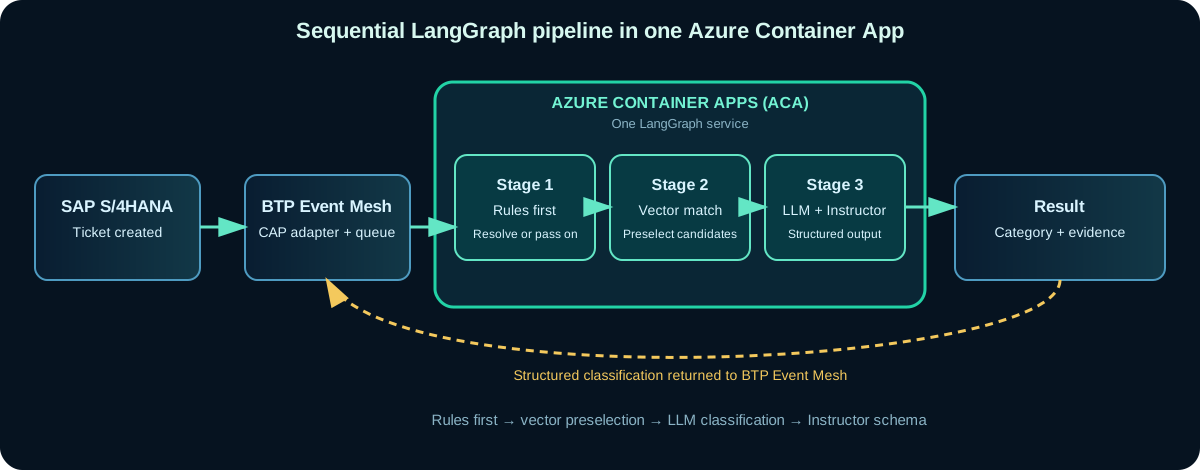
SAP S/4HANA emits a ticket event to SAP BTP Event Mesh. A CAP adapter validates and normalizes the payload before handing it to a unified LangGraph orchestration service hosted on Azure Container Apps over mTLS and OAuth JWT. That single graph owns the complete ordered path: rules first, vector preselection second, and LLM classification with Instructor-validated structured output last.
Stage 1: deterministic rules
The first LangGraph node applies regex, metadata, and hard business rules. Obvious cases resolve locally in under 10 ms. These rules are transparent, easy to test, and provide a stable first line of defense against unnecessary model calls.
Stage 2: vector preselection
Only tickets not caught by the rules node continue through the graph. The vector matching node embeds those tickets and compares them against historical, labeled cases in Azure AI Search or Azure Database for PostgreSQL with pgvector. Similarity thresholds preselect plausible categories and provide focused context for the final classifier; vector matching does not make the final decision.
Stage 3: LLM classification and structured output
The same LangGraph service sends the preselected candidates and supporting evidence to an LLM for classification. Instructor validates the response against a typed schema and generates the structured output containing the category, confidence, rationale, and evidence references. The workflow is bounded by explicit tools and a schema rather than open-ended model output. Full execution traces, from rule hits to agent tool calls, are captured via OpenTelemetry and LangWatch/LangSmith for real-time auditability and prompt evaluation.
Clean Core and asynchronous reliability
The SAP core remains untouched. Event Mesh, rate limiting, queues, and dead-letter retries sit in the BTP integration layer, so ticket creation is not coupled to container availability or model response time. This also gives operations teams a durable place to replay failed messages and inspect delivery state.
On Azure, one Container App hosts the Python LangGraph orchestration service and all three stages, scaling toward zero outside peak periods. The app can call private VNet-connected Azure ML or dedicated vLLM GPU endpoints for the LLM stage. Entra ID managed identities authenticate service-to-service calls without hardcoded API keys.
Business outcomes
The funnel is designed to deliver measurable operational value:
- Sub-200 ms triage for high-confidence rules and vector-preselected tickets.
- 65% lower LLM compute spend by reserving deep reasoning for ambiguous cases.
- 100% Clean Core compliance with zero modifications to SAP S/4HANA.
- Reliable peak handling through asynchronous queues, retries, and independently scaling compute tiers.
Architecture principles that transfer
This pattern is useful beyond ticket categorization. Any enterprise workflow that combines a governed system of record with expensive AI reasoning can benefit from the same separation: keep the source system stable, put policy and delivery guarantees at the integration boundary, and make model escalation an explicit business decision.
Ready to modernize your enterprise SAP and AI stack?