
Enterprise Fraud Detection: From Real-Time Machine Learning to Measurable Bottom-Line ROI
In industries that grant immediate credit, finance devices, or provide deferred payment services (including telecommunications, fintech, buy now pay later, and consumer lending), fraud is an evolving, highly organized threat.
From subscription fraud and device financing theft in telecom to synthetic identity creation and first party “bust out” fraud in digital lending, fraudulent actors constantly adapt to exploit vulnerabilities. Traditional rule based decision engines, while easy to audit, are increasingly brittle. They create high friction for legitimate customers while failing to detect novel fraud vectors.
At Modus Data, we design and integrate state of the art machine learning fraud architectures into corporate environments, building production systems that protect revenue without sacrificing customer experience.
1. The Power of Advanced Fraud Detection
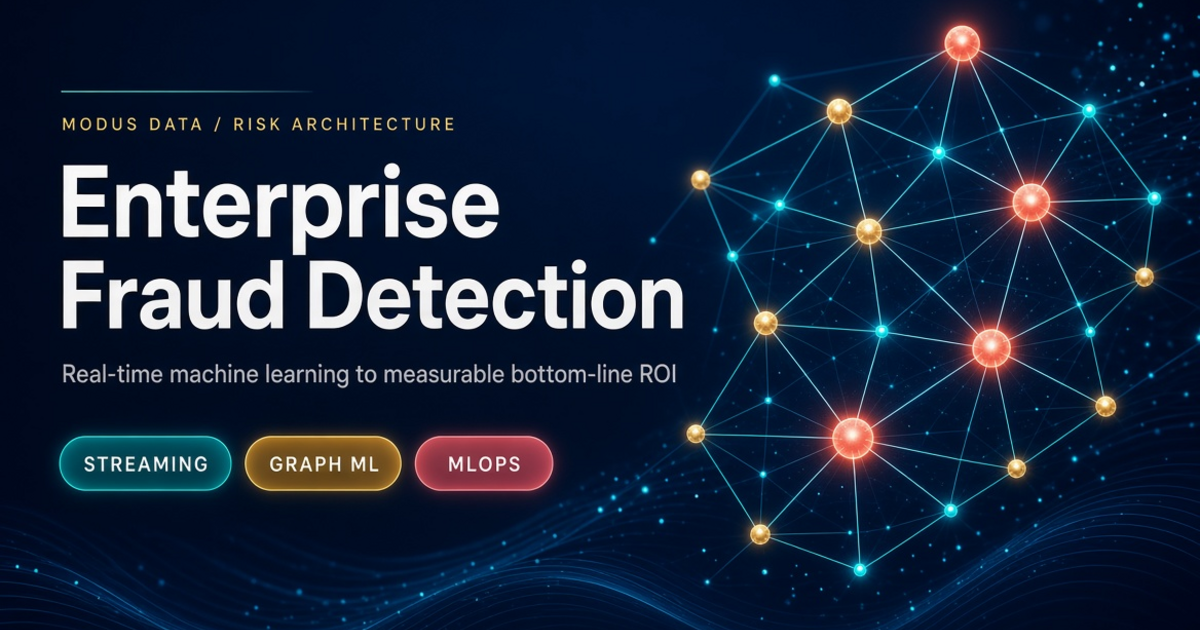
Modern enterprise fraud detection requires moving beyond static thresholds to dynamic, multi-layered machine learning architectures:
- Real Time Streaming Inference: Scoring transaction and application risk in under 100ms windows during onboarding, checkout, or service provisioning.
- Graph Neural Networks & Network Analytics: Detecting organized fraud rings, shared device clusters, and synthetic identity networks that traditional table based algorithms miss.
- Sequential & Behavioral Analytics: Utilizing recurrent architectures, Transformers, and gradient boosted trees (XGBoost, LightGBM) on high frequency velocity metrics, such as application burst rate, device fingerprint changes, and SIM swap history.
- Adaptive Anomaly Detection: Combining supervised models with unsupervised isolation forests and autoencoders to catch zero day fraud patterns before labeled training data becomes available.
2. Enterprise Workflow Integration: Precision Engineering
A fraud model with high offline accuracy is useless if it cannot seamlessly integrate into an enterprise decision architecture. Deploying models into production workflows requires specialized data and software engineering expertise:
- Low Latency Feature Stores: Orchestrating real time feature retrieval (such as streaming aggregates via Redis, Feast, or Databricks) so models have immediate context on historical activity.
- Hybrid Decision Engines: Coupling machine learning probabilities with hard compliance, credit bureau, and regulatory checks in a unified orchestration layer.
- Graceful Degradation & Fallbacks: Engineering fail safe defaults to ensure transaction processing remains active even during upstream service disruptions.
- MLOps & Drift Monitoring: Tracking feature drift, concept drift, and label delay (given that fraud outcomes often take 30 to 90 days to materialize) to trigger automated retraining pipelines.
3. Beyond Accuracy: Custom Business Metrics & Financial Utility
Standard data science evaluation metrics like AUC ROC, F1 Score, or Precision/Recall are blind to financial realities. They treat every misclassification as equal, whereas fraud decisioning is inherently asymmetric:
Financial Loss = (False Negatives x Direct Fraud Cost) + (False Positives x [Customer Friction + Lost LTV])
At Modus Data, we construct custom financial utility functions tailored to your specific business model:
- Cost of a False Negative (FN): Total charge off amount, unrecoverable device cost, collection expenses, and administrative overhead.
- Cost of a False Positive (FP): Lost lifetime value (LTV) of a rejected legitimate customer, manual review queue labor costs, and downstream brand churn.
- Optimal Operating Thresholds: Automatically tuning probability cutoff thresholds to maximize Net Recovered Margin rather than raw statistical accuracy.
4. Quantifying Impact: Controlled A/B Testing & Shadow Deployments
To prove the financial return on investment (ROI) of a new fraud engine, rigorous experimentation is mandatory before full production rollout:
- Shadow Deployments: Running new state of the art models alongside existing legacy engines in a zero risk environment to evaluate latency, feature stability, and predictive performance against historical outcomes.
- Champion-Challenger A/B Testing: Splitting application or transaction traffic between the incumbent system (Champion) and the new model (Challenger).
- Financial Outcome Attribution: Isolating key performance indicators over 30 to 120 day settlement windows, including Net Fraud Write Off Reduction, Manual Review Queue Volume Reduction, Customer Onboarding Conversion Rate Improvement, and Net Profit per 10,000 Transactions.
5. Domain Intelligence: Understanding Context Through Data Analysis
Algorithms are only as effective as the domain knowledge baked into their feature engineering. Building effective fraud models requires exploratory data analysis to understand the offender mindset:
- Behavioral Trajectories: Analyzing how fraudulent users navigate application forms, copy paste information, or alter identity attributes under friction.
- Graph Connectivity: Uncovering latent relationships between seemingly unrelated accounts, such as shared IP subnets, identical payout accounts, and device ID recycling.
- Ecosystem Understanding: Factoring in macro level context, including regional credit trends, telecommunication porting regulations, and seasonal promotional exploits.
Partner with Modus Data
Whether you are looking to replace legacy rule engines, build real time streaming feature stores, or quantify the true financial ROI of your risk pipelines, Modus Data provides high level data engineering and AI architecture tailored for enterprise scale.