
Agentic AI in Insurance: Automated Claims Processing with LangGraph and Enterprise Compliance
Insurance claims processing has long been burdened by manual bottlenecks, unstructured documentation, and strict regulatory mandates. Claims adjusters spend countless hours cross-referencing customer submissions against internal compliance documents, policy contracts, and regional legal frameworks. Traditional automation tools built on rigid rule engines or basic sequential prompt chains frequently break down when faced with complex, real-world edge cases.
At Modus Data, we build production-grade agentic AI architectures designed to transform this paradigm. By leveraging LangGraph, LangChain, and LangSmith, we engineer stateful systems capable of executing end-to-end claims pipelines while enforcing compliance, operational transparency, and seamless human oversight.
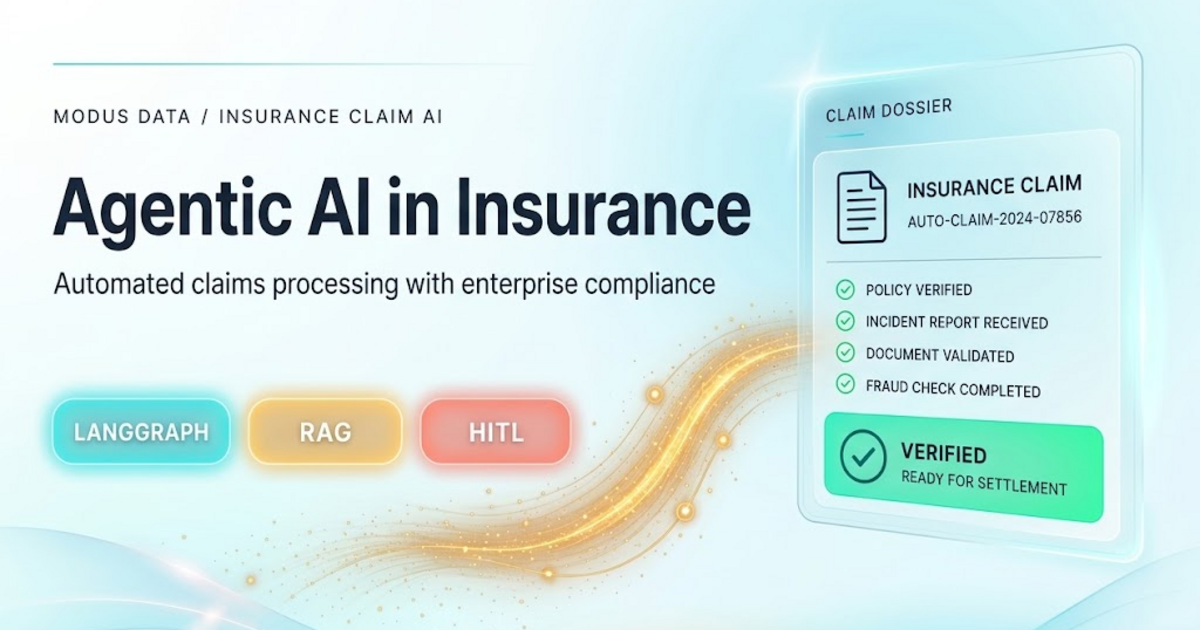
1. Why Agentic AI? State Machines and LangGraph
Unlike linear processing chains, agentic AI operates as a dynamic state machine capable of reasoning, tool usage, conditional branching, and self-reflection. LangGraph provides the underlying framework required to model sophisticated insurance workflows with precision.
Insurance decisions are rarely linear. An agent must ingest multi-modal claim data, query internal vector databases containing corporate compliance manuals, evaluate coverage thresholds, and determine risk levels. LangGraph enables the agent to cycle through these steps statefully, retaining context and re-evaluating decisions as new information is retrieved.
- Stateful Workflow Nodes: Every step in the claims lifecycle, from document parsing to compliance verification, is isolated within dedicated graph nodes.
- Conditional Routing: The system dynamically routes claims based on evaluated confidence scores, monetary value thresholds, and compliance risk flags.
- Built-In State Persistence: Workflow states are saved continuously, allowing multi-step processing over extended timeframes without losing context.
2. The End-to-End Claims Engine
The agentic processing engine operates through a tightly orchestrated sequence designed to maximize speed while guaranteeing regulatory alignment:
- Claim Ingestion & Fact Extraction: The agent ingests unstructured submissions, including incident reports, damage photos, medical bills, and police statements, extracting structured key entity data.
- Retrieval-Augmented Compliance Cross-Checking: Using advanced RAG architectures, the agent queries knowledge repositories containing current policy guidelines, coverage limits, and regional compliance requirements to verify claim validity.
- Deterministic Decision Evaluation: The agent compares extracted facts directly against compliance rules to evaluate liability, policy active dates, deductible structures, and potential fraud indicators.
- Autonomous Resolution or Escalation:
- Approval: Fully compliant, low-risk claims within pre-set authorization limits are approved with a complete audit justification.
- Declination: Non-covered claims are flagged with precise citations pointing to specific policy clauses, drafting a formal explanation for legal review.
- Human-in-the-Loop (HITL) Routing: Complex, ambiguous, or high-value claims pause automatically. The agent compiles an executive summary, highlights policy ambiguities, and routes the dossier to a human adjuster.
3. Production Infrastructure: Agent Server, Docker, and Kubernetes
Deploying agentic systems into mission-critical insurance infrastructure requires enterprise-grade containerization, scalability, and high availability.
We deploy agentic workflows using the LangGraph Deploy Agent Server, establishing a decoupled, asynchronous microservice architecture:
- Containerization with Docker & Compose: Standardized application environments packaged into lightweight Docker containers allow rapid local development, testing, and consistent staging deployments.
- Orchestration via Kubernetes: For enterprise production, agent instances are deployed across Kubernetes clusters, ensuring automatic scaling during sudden claim surges, such as post-storm natural disaster events.
- Asynchronous Queue Management: Long-running claims tasks run through background worker pools, keeping public-facing API endpoints responsive and low-latency.
4. Full Observability and Auditability via LangSmith
Insurance regulators and compliance officers require total clarity into automated decision-making. Black-box operations are not an option in regulated industries.
We integrate LangSmith across the entire execution graph to deliver continuous observability and deterministic debugging:
- Granular Trace Logging: Every prompt, tool execution, compliance retrieval result, and intermediate step is logged with complete execution history.
- Compliance Auditing: Compliance teams can inspect the exact policy documents and retrieval context referenced by the agent for any specific claim decision.
- Continuous Evaluation & Guardrails: Automated test suites run in parallel to detect drift, prompt injection attempts, or hallucination risks before changes reach production.
5. Quantifiable Business Impact
Transitioning from manual triage to an agentic claims engine fundamentally reshapes insurance operations:
- Dramatically Reduced Turnaround: Processing times drop from several business days to seconds for standard, fully compliant claims.
- Uncompromising Regulatory Compliance: Every decision is tied to the latest approved internal policy and applicable local requirements, with an audit trail for review.
- Enhanced Adjuster Efficiency: Repetitive administrative review is reduced, allowing senior adjusters to focus on high-value, sensitive, or highly complex files.
Partner with Modus Data
Ready to modernize your claims operations with production agentic AI? Modus Data designs, builds, and deploys scalable LangGraph and containerized AI solutions tailored for enterprise life, health, and property insurance environments.